

Under a New Wave: How the Market Is Responding to Another Series of Russian Attacks on Ports and Vessels
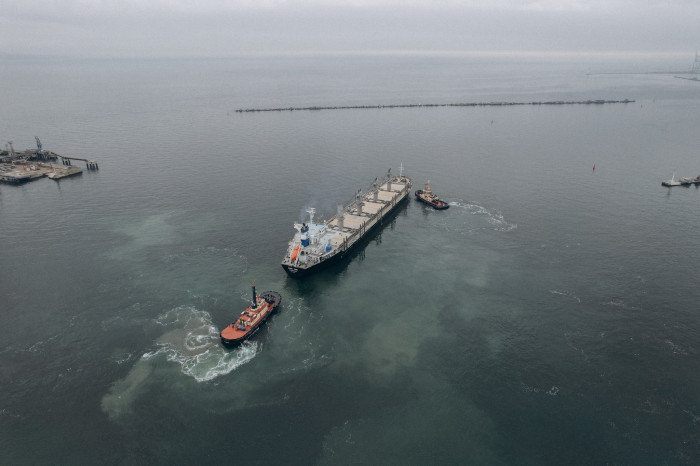
Shipowners are cautious about calling at Ukrainian ports, freight rates are rising, and agricultural producers expect a decrease in grain transshipment for export. At the same time, alternative logistics routes remain available, and market participants believe the situation will stabilize.
In July, the Ukrainian port industry experienced another wave of Russian shelling. This time, the aggressor is focused on targeting commercial fleet vessels. According to the Odesa Regional Prosecutor’s Office, within a month, the Russian army attacked 28 civilian vessels in the Odesa region: 21 people were killed, and another 34 were injured.
The highest number of casualties since the beginning of this wave of Russian terror was recorded on July 19, when the Russians struck a vessel carrying a cargo of corn near Odesa — nine crew members and a pilot from the Delta-Pilot branch of the Ukrainian Sea Ports Authority (USPA) were killed; eight sailors were rescued.
Undoubtedly, this situation affects the sentiment of shipowners. This time, they appear ready to pause operations longer than previously, when the Russians increased the intensity of strikes on ports at the end of 2025.
The Situation Is Difficult, but Time Will Tell
“Back then, the Russians ‘sent a message’ to shipowners, but they did not achieve the desired result: shipowners recovered quite quickly and resumed work. Unfortunately, this time the situation looks worse. Shipowners feel the threat to a greater extent, not to mention captains and crews who see this threat with their own eyes or even experience a strike directly,” industry sources explained to CFTS.
At the same time, the relevant ministry assures that the ports of Greater Odesa continue to operate routinely, and the Ukrainian maritime corridor remains functional, securing exports of Ukrainian products and the fulfillment of international contracts. “The Ministry is in constant contact with port authorities and market participants and continues to monitor the situation,” the department added.
As for the market participants themselves, they state the following:
-
“Some refuse to enter seaports, choosing the Danube instead, but at the same time, some do not want to go to any Ukrainian port at all,” noted Kateryna Kononenko, Operational Manager at Avalon Shipping.
-
“Owners have temporarily refused to call at our ports, given the number of vessels that have been hit,” commented Shota Khadjishvili, co-owner of Risoil, to CFTS.
-
“Port calls are being canceled, sailors are refusing to work on Ukrainian routes, and insurers recommend refraining from new voyages. And all this is happening just as the country enters peak harvest season,” states Pavlo Lynnyk, Director of GOL.
-
“Right now, the situation indeed seems different from the previous escalation — there are not many willing to go to our ports. But time will tell,” adds Oleksandr Nikulin, head of the shipping company Marevia.
The Turkish Shipowners’ Association called on shipping companies to review voyages to Russian and Ukrainian ports. Attacks on merchant ships continue and security conditions in the region are deteriorating, the association emphasized. Turkish vessels account for 40% of traffic through the Ukrainian maritime corridor, noted Andrii Klymenko, head of the Monitoring Group of the Institute for Black Sea Strategic Studies, earlier.
Freight Rates Rise Along with Risks
Previously, the danger forced shipping companies to implement enhanced safety procedures, while insurers significantly raised premiums for vessels entering Ukrainian waters. Now, industry insiders say insurance companies have suspended issuing new war risk policies and are reviewing premium levels.
Over the past week, freight rates have nearly doubled, reaching up to $40 per ton, industry sources say. “There is no established freight market with new rates right now: whatever rate you agree on, that will be the rate. What freight cost last week no longer matters today,” says Mykhailo Voronych, co-owner and CEO of Arista Trading.
“I have been working in the Black Sea market since 2017. Until 2022, it was difficult and sometimes tense, but overall predictable — with risks that were understood, calculated, and factored in. Then the Black Sea became a combat zone. We adapted by making decisions: whether to fix a voyage or not, take out additional insurance or not, accept the risk or reject the cargo,” says Oleksandr Nikulin.
According to him, shipowners’ willingness to work in a risk zone depends, among other things, on freight rates — specifically how well they cover insurance expenses.
“Previously, shipowners understood that insurance was expensive, but higher freight rates attracted them. Then freight fell and competition intensified. At some point, it became clear that if you constantly include additional war risk in the voyage price, you end up out of the market from a commercial standpoint. The cost of coverage became hard to justify within the voyage’s economics,” he explained.
Part of the market began working differently — with reduced coverage, and sometimes without additional risk coverage at all. This went on for a long time. However, with the current escalation at sea, such shipowners assess their risks quite differently now.
Grain Force Majeure
Most traders have paused new grain purchases or lowered procurement prices for the new crop. In particular, Nibulon informed the publication Latifundist that it would form grain purchase prices taking into account the additional costs of alternative export routes caused by Russian attacks on seaports and civilian vessels.
Maxym Hopka, an analyst at the Ukrainian Agribusiness Club (UCAB), compares the current situation not with the start of the full-scale war in February 2022, but with August–September 2023. At that time, after the termination of the Black Sea Grain Initiative, exports through the ports of Greater Odesa almost ground to a halt. On average, during August–September 2023, without the full operation of deep-water ports, Ukraine exported 3.65 million tons of agricultural products per month, mostly thanks to alternative routes, he recalls.
In 2024, seaports began working more stably, and between January and October, an average of about 4.43 million tons per month was shipped through them, compared to about 1.57 million tons via alternative routes.
UCAB predicts that July export volumes will reach up to three million tons, which is 30% less than in June, and in August this figure could drop by another half, excluding the pessimistic scenario — a complete stop of exports through deep-water ports.
Mykola Gorbachev, President of the Ukrainian Grain Association, says companies cannot predict “even the operational pace of ports for the coming days.” If a trader at an international company makes a miscalculation, those losses can be offset by results in other markets. Ukrainian companies have nothing to compensate them with.
Meanwhile, the Elevatorist portal writes that some farmers quickly reoriented toward the western border. In particular, the Chornotysivskyi Terminal already has orders for the current marketing year’s harvest.
Industry sources say that agricultural producers today do not face the heavy pressure of obligations that would be compounded by the limited capacity of railway crossings and other bottlenecks. Likewise, despite all the enemy’s efforts, there is no shortage of storage capacity. Therefore, there will be no repeat of the logistics crisis seen in 2022.
Containers — Bypassing the Ports
“The market is currently in a state of cautious waiting: everyone is calculating possible scenarios, and no one is rushing to make long-term decisions,” Dmytro Kazanin, Director and Owner of the logistics company TEUS, told CFTS.
Naturally, intense Russian strikes affect more than just shipments of agricultural products. They forced Maersk to suspend service through the terminal at the Chornomorsk Fish Port. Maersk Ukraine reported that, in particular, the vessel MEDKON MIRA was rerouted to the Romanian port of Constanța, from where the cargo will head to Ukraine, but without being unloaded at a seaport.
Meanwhile, MSC Ukraine reported that its office is temporarily closed, the company continues to work remotely until further notice, and all business processes are proceeding as normal.
The most optimistic expectations in the market are that the situation will stabilize in the coming weeks, according to CFTS interlocutors. They say that during this time, businesses will “manage” and overpay for logistics, after which cargo will continue to flow predominantly to seaports.
The Danube Is Always in Reserve
The enemy cannot significantly impact Ukraine’s exports: alternative routes have already been well-tested during the full-scale war. In 2022, instead of sending train cars and trucks to seaports, businesses directed them to Danube ports and western border crossings.
“Danube ports remain an alternative to seaports, but logistics can be more expensive compared to transport through the ports of Greater Odesa. That is why the market is actively calculating alternative routes today, but is in no rush to use them yet,” Kazanin explains.
The Danube market remains active, with rates rising by an average of about five dollars per ton, ASAP Agri reported.
At the same time, Kateryna Kononenko points out that the draft available in the Bystre Channel is barely sufficient even for a vessel in ballast: water levels are currently dropping, and loading a vessel to a 7-meter draft is presently impossible. In the Bystre mouth, the draft is 5.5 m, and near Izmail, it is 6.7 m.
“I used to think the Russian military command had some kind of plan to destroy Ukrainian supply chains. Then I realized there is only one instruction: strike everything that moves or stores something for shipment,” one of the sources told CFTS.
To support his point, he cited a recent Russian strike on the Mykolaiv Sea Port. On July 17, drones damaged three civilian vessels under foreign flags docked at the port. Two Ukrainians aboard a foreign vessel were killed. “The Russians hit a blocked port — for five years, not a single vessel has sailed to or from sea from Mykolaiv or Kherson. If anyone died, it was obviously maintenance personnel keeping idling ships operational. But if you monitor Russian media, the Russian military reports a successful strike on ships unloading Western weapons. This isn’t a strike on logistics; it’s just a strike for the sake of a strike,” the source told CFTS.
All of this is taking place against the backdrop of successful Ukrainian strikes on Russia’s shadow fleet. In total, between July 6 and July 22, as part of the Unmanned Systems Forces’ operation “MoLoChKa,” 196 vessels were hit in the Black and Azov Seas: 126 in the Sea of Azov and 70 in the Black Sea.
As Lloyd’s List notes, the warring sides increasingly view commercial ships as legitimate targets, exacerbating the overall crisis encompassing global shipping in 2026.