

Container Logistics After the New Wave of Attacks: Where Businesses Are Rerouting Cargo from Greater Odesa
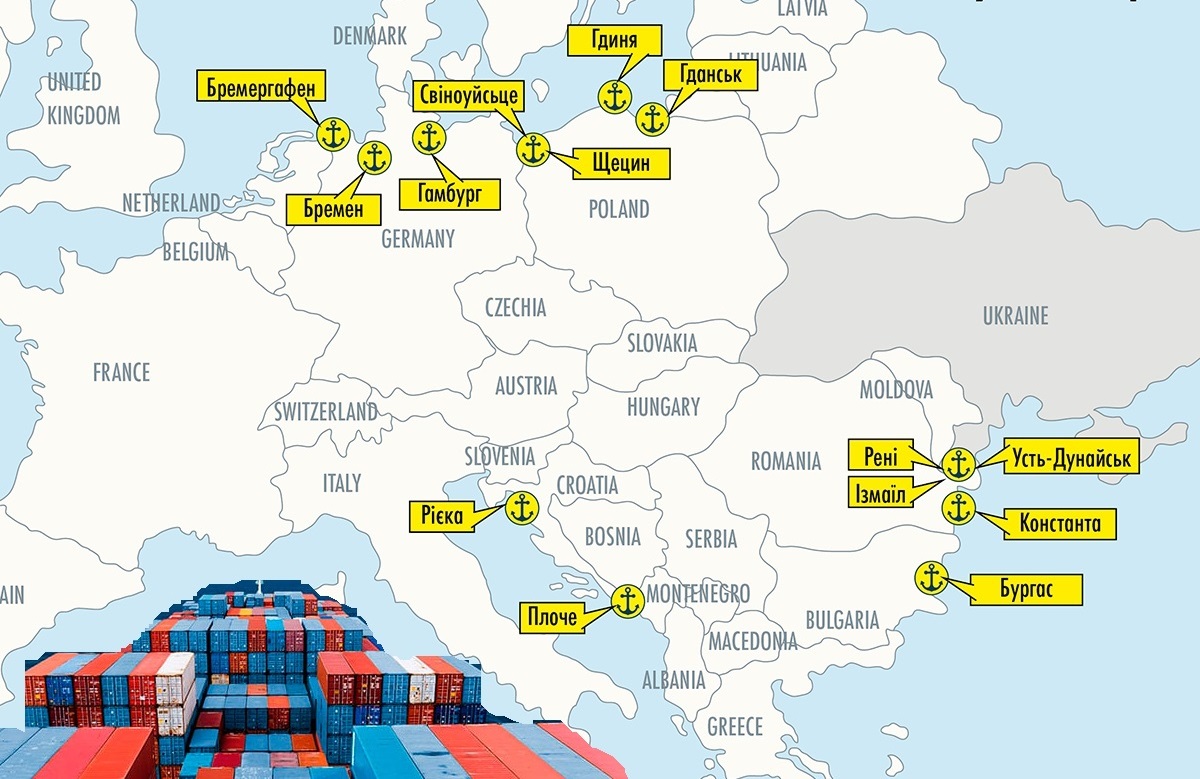
After more than four years of operating under shelling, the ports of Greater Odesa remain a key entry and exit point for Ukrainian trade. However, a new wave of attacks on port infrastructure and civilian shipping has once again changed the logic of the market. For an importer today, it is not only the freight rate that matters, but also the likelihood that the route will physically operate within the required timeframe. At the beginning of August, alternative container corridors could still be viewed as a contingency scenario. Now, they are once again becoming part of basic planning. Businesses are simultaneously looking at the Danube, Poland, Germany and the Benelux, but none of these directions can fully replace Greater Odesa: each has its own limitations in terms of capacity, transit times, availability of road transport and rail services.
What is happening with container flows right now
According to Volodymyr Guz, Commercial Director of Global Ocean Link, the market has entered a phase that can already be described as a local collapse of container flows. When the risk increases sharply, cargo does not disappear; instead, it starts looking for several alternative entry points at the same time. As a result, the pressure is immediately transferred to neighboring infrastructure.
The most telling example is Constanta. Based on GOL’s operational experience, finding a truck to pick up a container has become significantly more difficult, while the cost of road delivery from Constanta to Odesa has risen to approximately USD 4,000, compared with USD 1,200–1,500 just around two months ago. In other words, the problem today is not only getting a container to a European port, but also ensuring that it can be reliably picked up from there.
At the same time, interest in Reni is growing. The port is opening up to container flows, and some shipping lines are already directing cargo there. For importers, this creates the option of direct entry via Danube transshipment, bypassing Constanta. However, this option involves additional costs and depends on the specific shipping line and cargo.
“What we are seeing now is not simply an increase in the cost of one leg. There is a redistribution of flows: as soon as one corridor becomes risky, the alternatives quickly become overloaded. Therefore, the key question for the client is not where the rate is lower on paper, but where the container will actually move,” explains Volodymyr Guz.
Where cargo is already being redirected
From a practical standpoint, Greater Odesa, which had long remained the primary route for container imports, is now effectively being removed from the list of predictable scenarios. Following another escalation in attacks, businesses are forced to rapidly redirect flows to alternative corridors, primarily the Danube, Poland, and Germany–Benelux. At the same time, none of these options can fully replace the capacity of Greater Odesa ports.
Danube. After more than three years of operating under shelling, the ports of Greater Odesa have once again come under serious pressure, prompting the market to return to the Danube route, namely Reni and Izmail. However, the security situation is deteriorating here as well. In addition to risks to port infrastructure, the bridge in Mayaky remains a critical point along the route and an important element of road connectivity with southern Odesa region. An intensification of attacks or damage to this infrastructure could significantly complicate the evacuation of containers from the Danube ports. Therefore, the Danube today is more of a necessary alternative than an unconditionally safe contingency corridor.
A separate scenario is the direct entry of container cargo into Reni. Shipping lines are already directing cargo there, allowing importers to avoid transshipment through Constanta. However, the availability of this route depends on the specific shipping line, type of cargo and available infrastructure.
Romania. Constanta remains the obvious geographical alternative, but it is currently experiencing a particularly acute shortage of road transport and a sharp increase in the cost of the final leg. An expected rail solution could partially ease the pressure, but its effectiveness will depend on platform availability, transshipment, reloading and wagon changes.
Poland. This is the most straightforward and well-established land corridor. At the same time, the Polish rail network is operating close to its capacity limits. According to operational estimates provided to us, import shipments may already be scheduled approximately one and a half months ahead, while export shipments may be booked two to three months in advance.
Germany and the Benelux. The road leg is more expensive, but in some cases it offers greater predictability. The availability of transit hubs, warehouses and road transport makes it possible to organize delivery to Ukraine in approximately 7–10 days for the European leg without significantly exceeding the budget.
Which alternatives look good on paper but have limitations
The biggest mistake is to view any alternative port or rail corridor as a ready-made replacement for Odesa. In practice, capacity is determined by multiple bottlenecks: terminal slots, platform availability, locomotive capacity, the possibility of wagon changes or transshipment, border queues and truck availability.
The Romanian direction demonstrates this particularly well today: geographically, Constanta looks logical, but a shortage of trucks can completely change the economics of a container. Poland has more stable infrastructure, but its railway network is already overloaded. Reni can provide a shorter route for some cargo, but for now it is not a universal replacement for the entire container flow.
Another factor is risk within Ukraine itself. Due to attacks on railway infrastructure, including nodes in the eastern and central parts of the country, a long rail leg across Ukraine is also becoming less predictable. This is why, for some imports from China, a practical compromise is transportation via Poland by broad-gauge rail to Mostyska, followed by road delivery.
“If we look at the balance between price, transit time and risk, today I would consider a train to Mostyska followed by road transport. This reduces our dependence on the domestic rail leg while avoiding moving the entire route onto the road,” says Volodymyr Guz.
Comparing only the ocean freight rate can be misleading. For the actual delivery of a single container, the total cost must be calculated: ocean freight, port charges, storage, transshipment, rail or road transport, potential waiting time, additional border operations and the cost of delays for the business.
The point of origin is also critical: for imports from China, the economics of the same European routing can vary depending on the port of departure and the shipping line service.
The new normal is not an alternative route, but an alternative architecture
In 2022–2023, the market had already experienced a situation where the rate ceased to be the main criterion. Today, this logic is returning. If a container can be delivered to a port more cheaply but then waits two weeks for a truck or a train slot, the business pays for demurrage, storage, product shortages and lost sales.
That is why, for large retailers, manufacturers and importers with regular cargo flows, the solution is increasingly not to choose one “best” corridor, but to diversify.
“Given the current level of risk, businesses are forced to redistribute container flows across several alternative corridors: route part of the cargo through Poland, use Germany and the Benelux for urgent or high-value shipments, and consider the Danube as a separate operational scenario, taking into account not only the capabilities of the ports of Reni and Izmail, but also the security risks affecting inland infrastructure, including the bridge in Mayaky,” shares Volodymyr Guz, Commercial Director of GOL.
The current situation shows that the problem of Ukrainian container logistics can no longer be solved by simply finding one backup port. Each corridor has its own capacity limits, while war-related risks can change both transit times and rates within just a few days.
Therefore, a resilient model for an importer means having two or three routes prepared in advance, with different entry points and a fully calculated total cost. This model makes it possible not to wait until another corridor stops operating, but to shift the flow before capacity shortages turn into a crisis.
“Today, reliability is not a route that never changes. Reliability is the ability to quickly rebuild the supply chain and have a workable alternative in place before it is needed,” Volodymyr concludes.