New Challenges and New Opportunities: The Fertilizer Market in 2025

Despite the challenges of the full-scale war, Ukraine’s fertilizer market continues to grow, showing resilience and adaptability under the most difficult conditions. Before the full-scale invasion, fertilizers were imported from r__ї and біл__і, but everything changed once active hostilities began. Logistics chains and supplier structures have been reconfigured, and Ukrainian companies working in this market segment started seeking new creative solutions that ease their own operations and satisfy the needs of the end consumer for high-quality fertilizers—one of the key components to keeping the agricultural market functional. So let’s delve into the fertilizer market analytics in Ukraine and abroad in 2024 and at the beginning of 2025 together with Global Ocean Link.

January Trends on the European Market

The beginning of the new year for the European fertilizer market was marked by a sharp increase in prices. The cause lies in a host of interrelated macroeconomic factors. High gas prices, a weakened euro, low stocks, and logistical challenges have all contributed to fertilizers becoming more expensive. For example, the weak euro leads to higher import prices. This is precisely why prices for fertilizers in Germany and other European countries have risen since the beginning of the year. In particular, nitrogen prices went up, influenced by an increase in the cost of urea.

Another fertilizer that has increased in price is calcium ammonium nitrate. Also in Germany, the cost of ammonium nitrate–urea rose significantly. As we can see, the trend is clear.

Price Dynamics Last Year

Prices for urea and other fertilizers on the global market have always depended on a number of factors. Demand in large countries such as the United States, Brazil, and India has had a strong influence on them. Ammonia also deserves attention. Since it is a derivative of gas, the price of ammonia depends on gas prices. Although gas prices rose somewhat before last year’s planting season, that did not significantly affect the rise in the price of ammonia at that time. As for the current situation, compared to last year’s dynamics, price fluctuations upward are now much more palpable. And as already noted, this is influenced by a whole range of factors in the context of geopolitical and economic instability.

Last year in Ukraine, the ammonia market started with a deficit. This was partly caused by logistical supply chain problems and a lack of transshipment complexes at the border. Domestic manufacturers meet only part of the agricultural sector’s needs for this fertilizer.

Market Analysis 2024: Forecasts and Reality

Last year, the fertilizer market in Ukraine continued undergoing transformation. When the full-scale war began, sales volumes dropped by 50%. Some farmers used remaining stocks from previous years, while others completely abandoned the use of fertilizers for cost-saving reasons, given their economic difficulties.

Analysts had forecast that fertilizer demand would recover last year. The reason is simple: without fertilizers, crop yields decline. Thus, good fertilizers are not just an expense but an investment that brings a better harvest and higher profits.

Indeed, in 2024, these market-recovery trends have been observed. One leader in the Ukrainian fertilizer market is ammonium nitrate, as evidenced by consumer demand.

Let’s look at some fertilizers from a statistical perspective. For example, ammonium sulfate imports last year reached a record 435,500 tons, of which 182,600 tons were in just the last two months. More than 302,000 tons were imported from China. Among European supplier countries were Poland, Latvia, Belgium, and Serbia. As for Ukrainian production of ammonium sulfate, it totaled 90,000 tons over the year.

Overall imports of fertilizers last year rose by 14.5%. Key market trends are as follows:

  • Imports of three-component fertilizers increased;
  • Imports of nitrogen fertilizers also grew, reaching a total of 1.2567 million tons for the year.

Those are the key figures on last year’s fertilizer market.

It is worth noting that domestic Ukrainian production was unable to increase output due to shelling and the high price of gas. In this context, it is important to mention that:

  • The latest production run at Odesa Port Plant (ОПЗ) did not allow for new volumes of urea;
  • The launch of Dniproazot was postponed;
  • Rivneazot halted at the end of the fall due to insufficient energy capacity.

All of this coincided with a nearly 25% increase in gas prices.

GOL Company in the Ukrainian Fertilizer Market

GOL, as a leader in container and breakbulk shipping in Ukraine, pays great attention to the transportation of fertilizers. The company has 6,000 square meters of warehouse space for the safe storage of over 30,000 tons of fertilizers, located directly in the port area.

This is especially crucial for speeding up unloading services from vessels. Notably, among the 150,000 tons of product GOL transported last year, fertilizers were predominant—in particular, complex mineral fertilizers such as NPK, NP, and urea. Large volumes of urea and ammonium nitrate were also among the cargo.

Whether in bulk or in big bags, our company systematically delivers fertilizers, in batches from 3,000 to 10,000 tons, to Ukrainian ports. In the new year of 2025, we continue to maintain a high pace of operations and make a tangible contribution ensuring that Ukrainian farmers are supplied with the fertilizers they need for a good harvest.


Global Ocean Link in an expert column for UkrAgroConsult
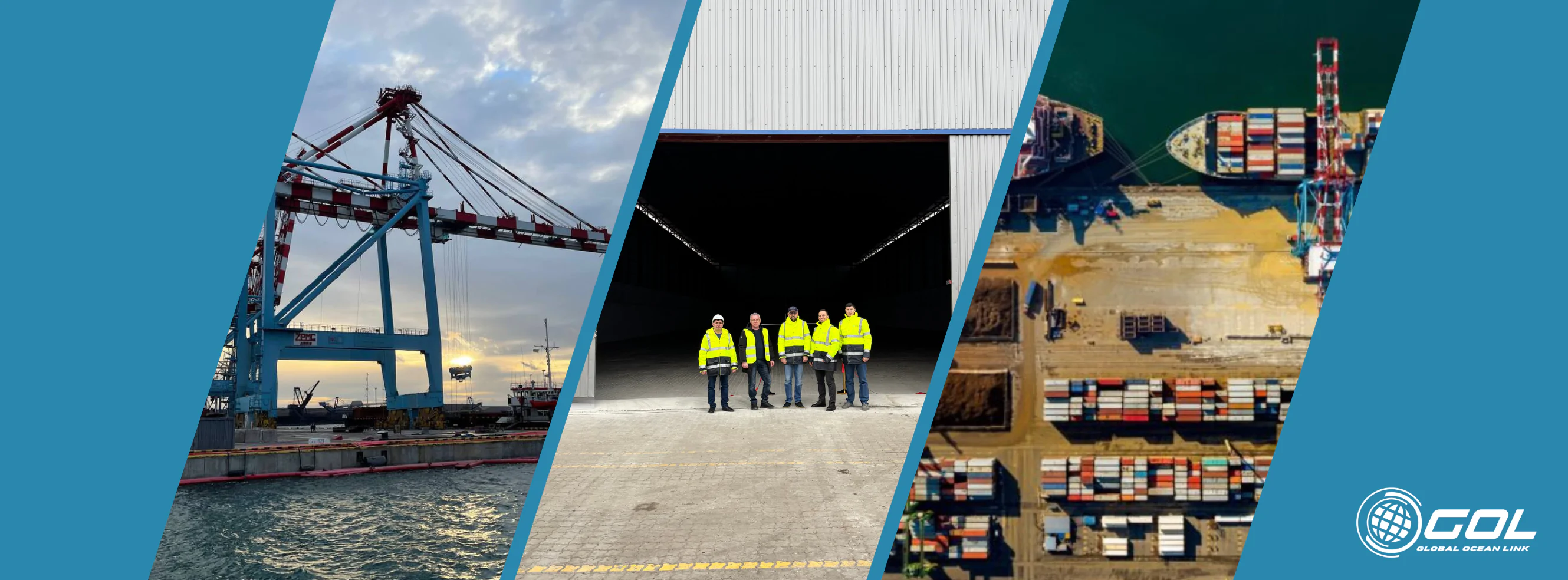
Global Ocean Link Opens Two New Warehouses at TIS Terminal

Global Ocean Link expands its presence at Ukraine’s deepest-water terminal by opening two new warehouse complexes at TIS territory. The terminal, equipped with three modern berths, ensures simultaneous handling of three vessels and efficient operations with cargo of any complexity.

Technical specifications of warehouse complexes:
• Total capacity: 25,000 tons
• 2 entrances for cargo vehicles
• 3 railway access tracks

Daily throughput capacity:
• Processing up to 200 trucks
• Handling up to 50 railway wagons

Advantages of own warehouse facilities:

  • Reliable storage of grain crops and fertilizers
  • Specialized conditions for moisture-sensitive cargo
  • Complete cargo operations cycle without third-party contractors
  • Optimization of logistics processes

The new warehouse facilities complement the company’s existing infrastructure and expand capabilities in providing comprehensive logistics services for import and export operations. This allows Global Ocean Link to provide a full range of services for cargo handling, storage, and processing directly at the terminal.

The opening of new warehouse facilities is an important step in the company’s development, aimed at improving customer service quality and strengthening Global Ocean Link’s position in Ukraine’s logistics market.

To explore our full range of services, please follow this link.

Season of Changes for Ukrainian Logistics: How 2024 Rewrote Container Transportation Rules During Wartime

2024 became another pivotal year for Ukrainian logistics. Military actions, the opening of container connections in Greater Odesa ports, changes in international trade, and infrastructure security challenges forced market participants to adapt to new realities. How has the industry changed? What innovations and solutions are helping to overcome difficulties? And what are the development prospects in such an unstable environment?

The challenges faced by Ukrainian logistics during the full-scale invasion are unprecedented. These include the need for operational solutions due to transport infrastructure destruction, port shelling, border blockades, reduced exports through traditional routes, and the search for new transit directions…

The constant threat of attacks forced higher security standards and the use of alternative routes – through Ukraine’s western borders (with expanded cooperation with neighboring countries) and the Danube (infrastructure development in Reni and Izmail).

In the second half of 2022 and 2023, the Danube helped compensate for losses from major port blockades, and its role cannot be underestimated. However, this year container shipments in this direction completely stopped, and infrastructure stands idle.

An important market factor was changes in insurance – the possibility to insure cargo against war risks emerged. At the beginning of 2024, this option didn’t exist. By mid-summer, it became possible within the country and at sea, though cargo couldn’t be insured while in port. Today, port insurance is available with limits of 100,000 euros and an average rate of 1.25%. This shift became another “building block” in stabilizing maritime transportation.

To optimize logistics processes, Ukrainian companies actively began implementing innovations. Electronic cargo management systems accelerated document flow and increased operational transparency, promoting consumer trust. Artificial intelligence usage ensures automation and acceleration of many work processes, allowing more rational use of human labor resources.

Despite difficulties, 2024 demonstrated the resilience and flexibility of Ukrainian logistics. It has many prospects, including:

EU Harmonization: Deepening relations with the European Union will lead to unified transportation standards and procedures.

Intermodal Terminals: Construction of new and modernization of existing terminals will facilitate cargo storage and handling.

Logistics Clusters: Creating regional centers uniting manufacturers, carriers, and distributors will make Ukrainian logistics more powerful.

Customs Procedures Reform: If transformations are real rather than “decorative,” this will promote better state-business interaction.

Regarding positive future changes, they’re evident from this year’s developments. The last quarter of 2024 saw major changes in container transportation. For example, MAERSK is placing direct vessels to its transit hub – Port Said. Also, though unconfirmed, CMA reportedly plans a direct container launch to Brooklyn in late December.

Piggyback transportation is also worth mentioning. And despite the low market for road transportation, movement toward EU integration is observed. In the grain market, traders essentially have no margin left.

Thus, this segment is gradually shifting from container transportation to bulk direction, where larger batches can achieve cheaper logistics. However, these shipments are still lower than the same period last year. Overall, the container transportation market currently comprises one-third of pre-war volumes, which is quite a good indicator. The full-scale war became a serious test for Ukrainian logistics, but new conditions sparked industry rethinking and modernization.

Container transportation proved its importance in maintaining the country’s economic stability, and 2024 became a year of significant changes that will determine logistics industry development for years. Future success will depend on military-political situation stability, reforms, and investments in infrastructure and human capital.