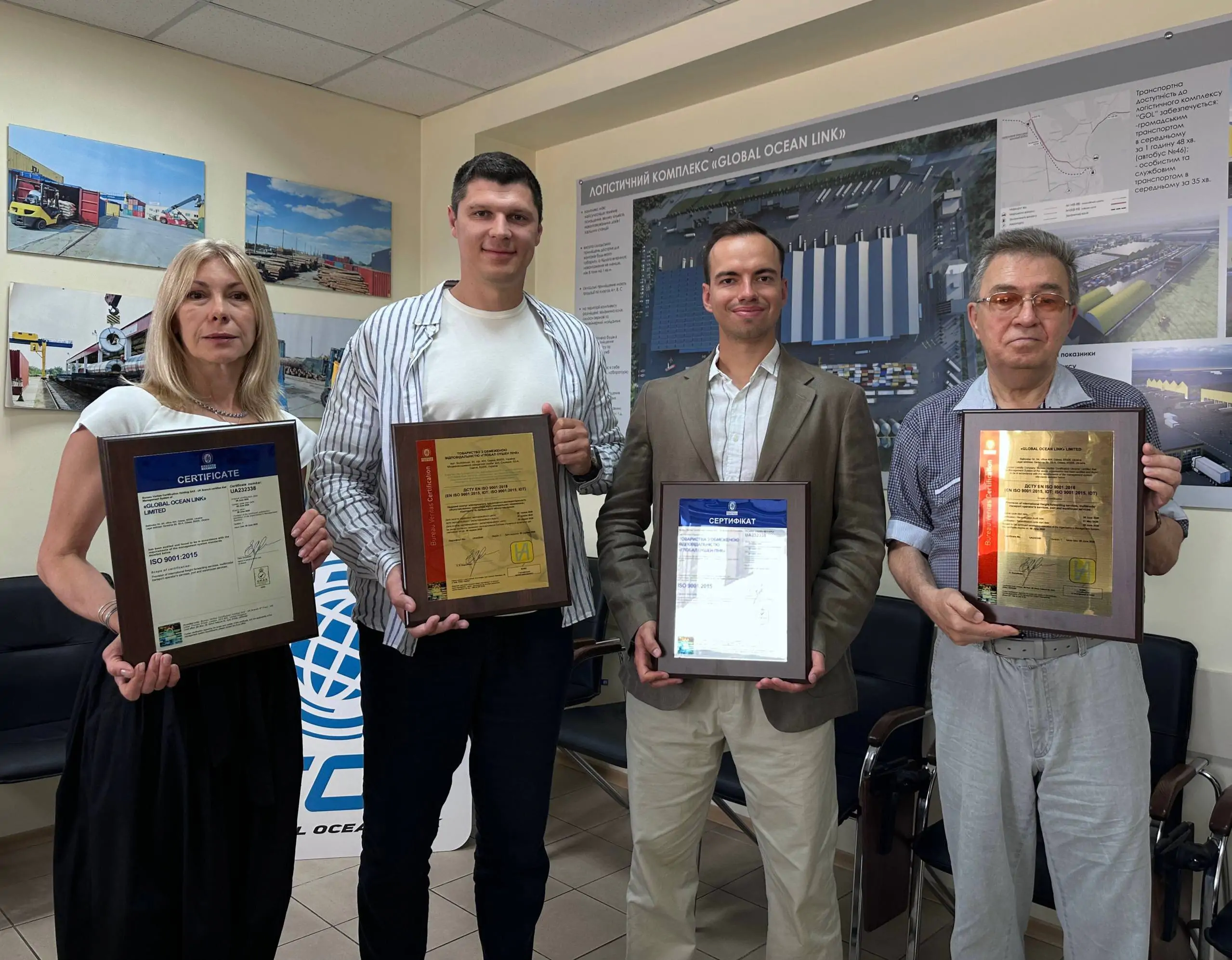
The GOL trademark has been valued at UAH 54.8 million.

Global Ocean Link has been operating in the Ukrainian and European transport and logistics market for more than 15 years, specializing in containerized sea freight and developing multimodal solutions. Today, the group of companies has offices in Odesa, Kyiv, Lviv, and Vinnytsia, as well as in Vilnius (Lithuania) and Gdańsk (Poland); the team consists of more than 150 professionals. Every 14th container passing through Ukraine is handled under the GOL brand.

As of August 1, 2025, the market value of the intellectual property rights to the GOL trademark (Ukrainian Trademark Certificate No. 230266 dated August 10, 2017) amounted to UAH 54,818,360 (approximately USD 1.31 million at the official NBU exchange rate on the valuation date), excluding VAT. The valuation was conducted by the Institute of Valuation and Forensic Expertise LLC using the income approach and the Relief from Royalty Method, in accordance with the National Valuation Standards of Ukraine and the International Valuation Standards (IVS, ISO 10668).

The calculation was based on the consolidated financial performance of the Global Ocean Link group in Ukraine, Lithuania, and Poland for 2022–2024. Gross profit was selected as the royalty base — an approach recognized by international practice (Brand Finance, Interbrand, and IVS recommendations) as methodologically appropriate for the logistics industry due to the high share of transit costs within revenue. The applied royalty rate of 3% of gross profit corresponds to the average market level for the logistics sector and reflects GOL’s positioning as a strong regional operator with an international presence.

The market valuation of the trademark is, above all, a management decision-making tool. For Global Ocean Link, it provides:

• transparent justification of the efficiency of trademark utilization within the group companies in Ukraine, Lithuania, and Poland;

• structuring of licensing relationships between the group’s legal entities (royalties, contribution to authorized capital);

• proper recognition of intangible assets in financial statements in accordance with IFRS standards;

• readiness for dialogue with international partners and investors based on economically substantiated value rather than subjective assessments.

The current valuation reflects the trademark’s market position as of a specific date. Global Ocean Link’s strategy is aimed at scaling this value through the expansion of multimodal coverage within a single logistics chain (sea – road – rail – air), strengthening its European offices in Lithuania and Poland, developing warehousing and built-to-suit solutions, as well as implementing joint venture projects with clients. These directions form the foundation for further value growth — both of the trademark and of the business as a whole.

Air transportation of fertilized sturgeon eggs

Recently, our team successfully completed a complex shipment of fertilized sturgeon eggs along the route: Ukraine — Chișinău — Yerevan

The primary challenge was to maintain a stable temperature and minimize transit time. Given the delicate nature of the cargo, refrigerated transportation was selected. In Chișinău, our agent conducted a thorough inspection, verifying the packaging, transport parameters, and all supporting documentation.
Thanks to the seamless coordination of all parties involved, the cargo was delivered on time and in full compliance with all safety requirements.

Hero of Logistics: Artem Hutsuliuk
✉️ [email protected]

Air freight is storming again: why finding a flight is no longer enough for business

Even in early 2026, one might have had the impression that the air cargo market had begun to calm down. After the high volatility of previous periods, rates on the Asia-Europe route appeared more restrained, and the market showed signals of aligning supply and demand. In the first quarter, the rate on the Asia-Europe corridor dropped to $3.64 per kilogram, compared to $5.28 a year earlier. But air freight is a logistics segment where calm almost never means stability.

Recent weeks have proven this once again. Global air cargo transportation is back to operating in a rapid restructuring mode. The year started with strong demand: IATA recorded a growth in global air cargo demand of 5.6% in January and 11.2% in February year-on-year. However, by spring, the market began moving again under geopolitical pressure due to the conflict in the Middle East, problems with air routes, rising fuel prices, and a new shift of some urgent cargo from sea to air. By mid-April, the average global spot rate rose to $3.76 per kilogram, which is 37% higher than a year ago.

“The problem with the market today is not just that air freight can become more expensive. The problem is that it becomes less predictable precisely at the moment when businesses need predictability the most. When rates on certain routes jump by tens of percent, when hub facilities face capacity reductions, and cargo follows detour routes, a company can no longer afford the luxury of thinking in terms of a single flight or a single rate. Due to current disruptions, forwarders began looking for completely atypical routes for cargo from Asia to Europe, even including transit through Los Angeles. This is a good indicator of how atypical the market has become,” – Pavlo Lynnyk, CEO of GOL.

For Ukrainian business, this change is particularly noticeable. Since the closure of Ukraine’s airspace, air transportation has long ceased to be a direct service. Today, it is a multi-link system involving an Asian departure airport, a European entry hub, a road leg, customs coordination, a delivery schedule, and a set of risks that must be kept under control at every stage. This is why the real price of air logistics consists of more than just the rate per kilogram. It consists of available capacity, the right hub, connection time, risk of delay, and the ability to quickly switch routes. In other words, consolidation, choosing the optimal hub, long-term contracts, flexible routing, and the Air + Road combination have become basic cost management tools today rather than an option.

In 2026, air freight no longer sells speed as its primary value. It sells control. Control over the delivery time. Control over the situation when the sea has become too slow, and production or sales can no longer wait, the CEO of GOL shares his opinion. This is why air freight is now especially important for electronics, pharmaceuticals, auto components, high-value goods, and urgent industrial components.

“Therefore, for business today, the question is no longer: ‘How much does air freight cost?’ It is more correct to ask another question: ‘Which part of my supply chain should air freight protect—and how to do it without losing control over the economics?’ This is where modern logistics begins. Not with an individual shipment. And not even with an individual tariff. But with the ability to assemble the right delivery model for a specific risk, a specific product, and a specific business goal. Therefore, in this new reality, the role of the logistics company is also changing. Previously, the market often looked at a forwarder as someone who organizes transportation. Today, that is no longer enough. Business needs a partner who does not just find a route but manages the entire logic of the supply: from choosing the corridor and hub to the cost model and backup scenarios. And this is exactly the role our company is moving toward today,” – Pavlo Lynnyk, CEO of GOL.

Multimodal Delivery of Battery Energy Storage Systems (BESS) from China to Ukraine

Our team has successfully completed the transportation of 20 BESS containers with a total capacity of 120 MW via the route: Shanghai — Gdańsk — Kyiv Region. This cargo required exceptional attention to safety, meticulous coordination at every stage, and strict adherence to international standards for transporting lithium-ion systems.

To ensure maximum safety and meet all technical requirements, High Cube (HC) containers were utilized, perfectly suited to the specific nature of the cargo.

Hero of Logistics: Andrii Sharkhun
✉️: [email protected]


Successful humanitarian aid delivery — 59 units of special-purpose vehicles for Ukraine

Route: Taiwan ➔ Gdańsk ➔ Lviv

For the transportation of this special equipment, various types of 40-foot containers were used. Fire trucks were placed on 9 Flat Rack platforms to ensure the secure fastening of oversized units. At the same time, ambulances were delivered in 31 High Cube containers — the increased height of these containers provided the necessary space for safe sea transit.

We are proud to be part of such projects.
Global Ocean Link — your reliable logistics partner 🌐

Logistics Hero: Doda Rostyslav
✉️: [email protected]


Logistics Ratings Missing in Ukraine: How a Client Can Distinguish “Cheap” from “Reliable”

Pricing issues in the logistics industry are extremely relevant today. A particularly significant aspect is that an emphasis on “cheap at the start” typically results in a much higher cost of error later. This can manifest as breaches of agreed deadlines, downtime, fines, or loss of clients. That is why Ukraine needs a reliability rating for logistics companies, rather than a price ranking.

What the Market Watches vs. What it Overlooks

One of the key problems facing the modern logistics services market is that the focus is centered on the rate, while a whole range of other factors remains overlooked, namely:

  • Risk profile;

  • Service discipline;

  • Readiness for force majeure;

  • Transparency.

Therefore, a selective focus on the price factor becomes the fundamental error in selection, leading to partnerships that ultimately disappoint.

Current Insights into the Logistics Sector

To address this, let’s highlight three key metrics that are most significant for assessing a logistics partner’s reliability:

  1. Speed and quality of response to force majeure;

  2. Transparency and process control;

  3. Company experience and longevity, which serves as evidence of reliability.

In my opinion, it is equally vital to consider scenarios where a low freight rate hides the exclusion of THC (Terminal Handling Charges), local port fees, storage, or free time. Furthermore, vehicle downtime often occurs, fuel surcharges appear, and there are re-issuances of bills of lading or additional certificates that were supposedly agreed upon in advance.

For example: A client saves money at the start but loses both time and money later. Consider a customs clearance case where a competitor offered a 30% cheaper rate for filing a Customs Declaration. However, the “cheapest” broker submitted an incorrect commodity code, forcing the importer to pay an additional 1.5% in duties—amounting to approximately $10,000.

It is also crucial to watch for “red flags” that indicate reliability is unlikely. This includes “guarantees” of transit time and cargo safety. While these factors can be managed with care, they cannot be legally guaranteed.

5 Significant Criteria to Consider When Choosing a Logistics Provider

When asked about selection criteria, I believe you should focus on the following:

  • KPIs for maintaining ETD conditions: % of shipments without disruptions (no rollovers, no route changes due to the forwarder’s fault, no critical delays);

  • KPIs for maintaining quoted costs: % of shipments without additional unplanned expenses;

  • Volume metrics: Not the primary factor, but important to show how the company performs under load;

  • Annual volume: (TEU / MT / trucks / charters);

  • Client retention rate: (Year-over-year).

Additionally, a global agent network should be added to this list.

Additional Criteria for a Reliable Carrier

Beyond the aforementioned points, you should also consider:

  • The carrier’s experience in their specific niche;

  • Transit times;

  • Availability of their own fleet;

  • Recommendations from B2B clients;

  • Pricing transparency and a clear breakdown of all services included in the tariff;

  • Level of customer service, including 24/7 support, convenient communication channels, and cargo status reporting;

  • Ability to offer alternative routes in case of force majeure;

  • Capability to provide necessary shipping conditions for specialized cargo (e.g., hazardous materials, etc.).

If you take all these factors into account when choosing a freight forwarder, it will significantly increase the chances of a successful partnership.

From Raw Material Import to Finished Product Export

The Global Ocean Link team recently completed a compelling case study involving a full-cycle logistics solution for a tobacco manufacturer.
The first stage involved the delivery of cigarette filters from Malaysia to Ukraine under FCA terms, requiring strict adherence to specific temperature and humidity levels. The transportation was carried out with transshipment in Gdansk or Koper. Throughout all stages, the cargo was transported in refrigerated conditions, with each pallet equipped with a data logger to continuously monitor temperature and humidity along the entire route. Upon arrival, the client verified the logger data and confirmed that there were no deviations.
Following production, these filters are used to manufacture cigarettes, after which we manage the export of the finished goods to Saudi Arabia via the Port of Constanta. This process is also handled in reefers, maintaining rigorous temperature and humidity control at every stage of transport.

Logistics Hero: Yuliya Artyukh
✉️: [email protected]


Logistics Challenges, Risks, and Trends in 2026

In the challenging conditions of wartime, Ukrainian logistics continues to face a wide range of risks and challenges. These are constantly evolving, as the field is highly dynamic and influenced by both domestic processes and international factors.

CEO Pavlo Lynnyk and Commercial Director Volodymyr Huz discuss the current context for logistics companies.

What logistics solutions do you consider most effective for mitigating risks in 2026?

Volodymyr Huz: In 2026, the key factor for resilience is diversification and supply chain controllability, rather than relying on a single “ideal” route. When distributing flows, one must consider local risks perceived by importers. Insurance and tariffs are also vital issues. It is particularly worth noting that insurance services have surged in price and continue to get more expensive—rising from 1% to 3.5%.

Poland remains a key hub. We can assume that in March, this traffic will continue to be oversaturated. However, it remains effective as it allows for work with various transport modes—container ships, trucks, and rail. By the way, rail can reach the final destination directly (which is cheaper but not very fast) or, for example, go to the Mostyska border crossing, from where the cargo can be picked up by truck.

One should not forget other European alternatives. Constanța hasn’t gone anywhere and has become more active as of today. It is a sort of European “Plan B.” Similarly, Rijeka remains a solid hub for rail service via Budapest, which is a good option for certain importers.

If we are talking about connections with Northern and Central Europe, the USA, Canada, and South America, then Germany and the Benelux countries can be considered alternatives to Poland. This is relevant for high-margin goods where one wants to avoid the risks in Poland, such as the port closures seen in early January.

Pavlo Lynnyk: From our experience, the most effective solutions are: multimodal routes with the ability to quickly switch between ports, countries, and transport modes; the regionalization of logistics and use of dry ports, border hubs, and temporary storage warehouses closer to the client; and combining shipping lines with alternative services to avoid dependence on a single global player.

Effectively, in 2026, the winner is not the one who is cheaper, but the one who is more stable and adapts faster.

What changes in carrier behavior are you already recording at the beginning of 2026, and what do you expect in the next 6–12 months? Are you seeing a return of the fleet to traditional routes, or is the priority still on alternative paths?

Volodymyr Huz: Regarding road carriers, we are currently observing an increase in tariffs. This applies to truck and container transport both within Ukraine and in international logistics. However, it is important to understand the market context: prices are simply rising to market levels and moving away from the dumping that characterized last year. Therefore, current price levels are market-optimal rather than inflated.

An identical trend is observed in the break-bulk fleet. Small dry-cargo vessels (3,000–5,000 tons) have nearly doubled their freight costs in the Black Sea. For example, six months ago, import tariffs to Ukraine were $20–$25 per ton; now they are around $40 per ton.

Conversely, container prices to Ukraine continue to decrease. Precise pricing depends on the factor of traffic returning to the Suez Canal. As of now, CMA has announced they are not returning, while MAERSK has returned with two services.

Pavlo Lynnyk: Overall, carriers are becoming more pragmatic. they are conducting fewer experiments and focusing more on profitable and predictable routes. Transport prices are also rising. The winner is the one who provided work early on, but no one intends to hold back tariffs or prices while demand exists.

Thus, alternative routes (via Poland, the Baltics, Southern Europe, and multimodal corridors) remain a priority, especially for Eastern Europe and Ukraine. At the same time, carriers are reducing their risk tolerance. They are reviewing terms more frequently, introducing surcharges, and shortening free time.

What do you think will be the main challenges in your industry throughout 2026?

Volodymyr Huz: It is important to mention the underloaded export format in Ukraine regarding containers. Imports heavily prevail over exports. There are currently no signs that Ukrainian exports will begin to be accounted for in full-scale volumes. Therefore, I predict this trend will persist for the near future, and possibly for all of 2026.

Pavlo Lynnyk: Major trends will also include the unpredictability of geopolitics and regulatory decisions, which can instantly change routes, rates, and infrastructure availability; a deficit of quality infrastructure on alternative corridors, as warehouses, terminals, and rail hubs do not always keep up with demand; and pressure on margins, as clients expect “peacetime” service levels despite increased costs and risks.

Additionally, a human resources challenge is emerging. There is a growing need not just for logisticians, but for specialists who think in terms of scenarios, risks, and finance.

Adapting to all these challenges is a necessity for a modern logistics company. You either adjust to them or leave the market—these are today’s realities.

How does the war in the Middle East affect cargo delivery to Ukraine?

Against the backdrop of strikes on Iran, industry media are recording a sharp deterioration in shipping conditions in the region: container carriers are introducing emergency measures to discharge cargo at the nearest safe ports and adding extra surcharges, some major lines are suspending new bookings on Middle Eastern routes, and insurers are canceling or radically revising rates.

What is scarier for the market: physical closure or a soft blockade? In practice, it is the soft blockade, driven by rising military risks and insurance costs, that often hits faster than a formal closure. Even without a complete shutdown of the route, the market loses predictability, available slots, and transparent pricing.

What can be advised to shippers and businesses?

Firstly, temporarily look toward other sales markets as an anti-crisis measure during this period of turbulence.

Secondly, try alternative logistics via the Western side. For example, the port of Jeddah, followed by rail delivery to the required point, depending on the geography and availability of the land leg.

Which cargoes, besides oil, will feel the consequences?

Everything related to the transportation of oil, or if the cargo contains refined oil products. According to GOL’s assessment, in the short term, the consequences will be felt by 15-20%, and if the conflict lasts more than 30 days – by 90% of all commodity groups, due to the cascading effect of freight, insurance, and schedule disruptions.

Will this situation affect cargo delivery to Ukraine and the Black Sea region as a whole?

The key effect of the current turbulence for Ukraine and the Black Sea region is through rates, service availability, and carrier decisions, rather than just the fact of escalation itself.

We see that some carriers are stopping shipments or transit for certain Middle Eastern countries, while others maintain delivery options but introduce outrageous surcharges.

Ukrainian business is ready to pay incredible money to keep contracts and bring goods on time, but obviously, this will not be the case for everyone.

Next, market mechanics kick in: if many lines have indeed canceled service for Middle Eastern traffic, then services, including Chinese ones, may turn out to be underloaded without this cargo flow. Consequently, they will have to be urgently loaded for other directions, which could potentially cause prices to roll back down.

Overall, this geopolitical instability increases ship freight prices. For bulk shipments, imports and exports from Ukraine are currently rising on average by five to ten dollars per ton.

At the same time, the direct trade blow from severing relations specifically with Iran is minimal for Ukraine. Imports from Iran in 2025 were estimated at only $17.5 million (about 0.02% of total imports), and exports were effectively at the level of statistical error.

But indirect risks for logistics and prices are significantly higher due to Ukraine’s ties with other Gulf countries.

Amidst the spike in energy prices, pressure is mounting on transportation costs and the cost of entire commodity groups. Separately, it can be noted that if such price dynamics hold for a month, Ukraine’s trade balance losses on oil and gas could amount to about $140 million for the period. At the same time, logistically, deliveries to countries in the region can continue through alternative gates – the ports of the Red Sea and Oman; therefore, it is more a matter of price, timing, and capacity availability than a complete halt in trade.

In general, the market is entering a phase where the speed of supply chain reaction becomes decisive. The longer military risks, insurance restrictions, and chaotic carrier decisions on services and bookings persist, the faster local turbulence turns into systemic price increases and capacity shortages far beyond the region.

Therefore, the coming weeks are about pragmatic risk management: alternative routes, flexibility, revision of delivery terms and conditions, and a readiness to pay for predictability where it still exists.

Air freight of ADR cargo to Nigeria

The Global Ocean Link team continues to expand the geography of complex logistics projects. Recently, we successfully executed the air transportation of chemical products classified as ADR (dangerous goods) on a route via Frankfurt to Nigeria.

The cargo was packaged in strict accordance with ADR requirements, ensuring safe transportation and full compliance with international regulations for the carriage of dangerous goods. Logistics coordination and delivery support were managed by Associate Partner Anna Khakhva, who ensured control over all stages of transportation—from cargo pickup to its departure through the international air hub.

Thanks to seamless teamwork and precise coordination of all processes, the cargo was delivered to the recipient within one week from the moment of pickup. Such shipments require experience, precision, and a deep understanding of international logistics standards—qualities that allow us to effectively implement even the most challenging routes.

Logistics Hero: Anna Khakhva

Email: [email protected]

BESS system from China to Ukraine

The main challenge of the project was the transportation of equipment from the Port of Shanghai to Odesa, which required a combined approach to packaging and logistics: the main 10-foot module was securely loaded onto a Flat Rack for the safe transport of oversized cargo, while the storage batteries were transported separately in a 20-foot container in strict compliance with all safety regulations.

In addition to energy storage systems (BESS), we are actively involved in the delivery of solar panels from China, utilizing key European ports such as Gdansk, Rotterdam, Antwerp, and Koper. For every order, we select the discharge port individually, focusing on optimal delivery times and the most cost-effective price for the client. We take pride in our team’s professionalism and are always open to discussing logistics strategies for your projects.

Logistics Hero: Artem Hutsuliuk

Email: [email protected]

Cosmetics delivery to Ukraine in just 3 days

Recently, Rostyslav Doda, Head of the Logistics Department, successfully executed a complex logistics case: 18 pallets of cosmetics from China, with cargo picked up from 8 different factories simultaneously.

The operation included organized consolidation, air freight to Budapest involving GOL Hungary, and rapid ground delivery directly to the warehouse in Brovary.

Maximum coordination of processes, full control at every stage, and seamless teamwork ensured the fast, safe, and timely transportation of the cargo.

Logistics Hero: Rostyslav Doda

Email: [email protected]